
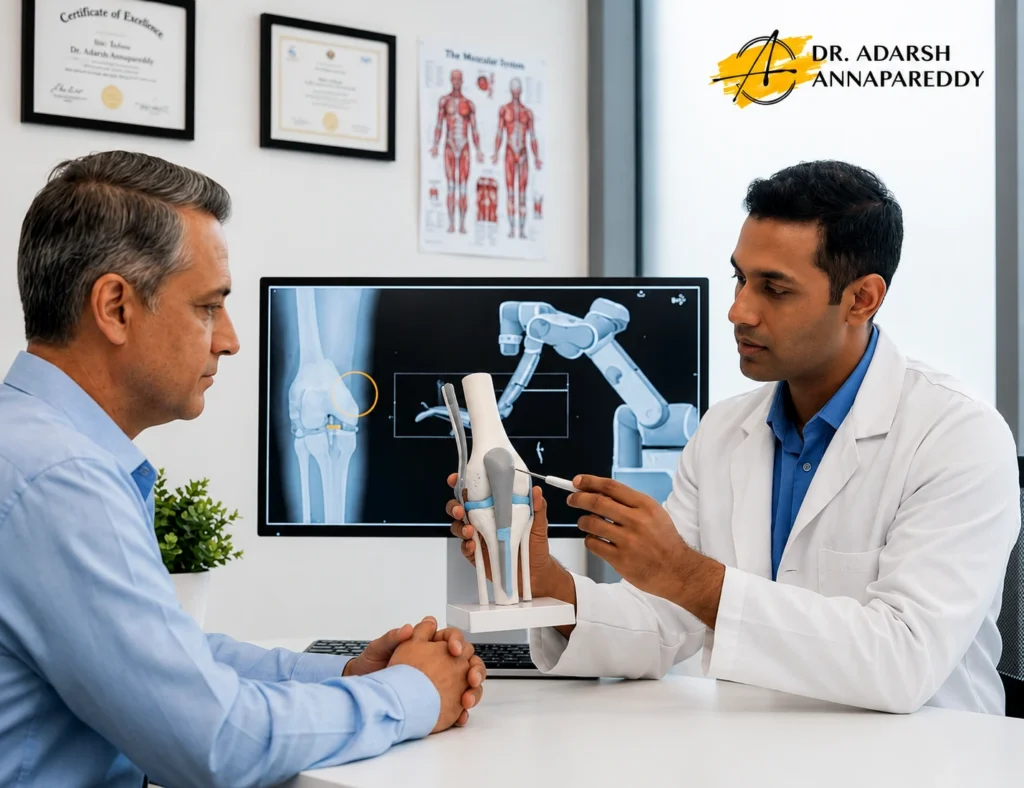
The knee joint is a hinge joint that connects the thigh bone and the shin bone and it contains a host of bones, menisci and 4 different ligaments- all working together to make mobility easy and convenient. Since there are so many working parts here, you will notice pain, stiffness and other symptoms when even one of them is not functioning in the way it is supposed to. Such times call for the use of a specialised type of procedure- partial knee replacement, which can help if only some parts of your knee joint are damaged or injured. Robotic surgery is a huge advancement in this field, as it has been touted to be very effective.
What Is Robotic Partial Knee Replacement?
Robotic partial knee replacement surgery is a specialised procedure where the surgeon removes only the worn out, diseased or injured parts of your joint and NOT the whole joint itself surgically. This can be done because the robot gives the surgeon a detailed 3D image of the knee joint – allowing the accurate removal of only the affected parts, while the healthy components of the native joint are retained. An artificial implant is surgically inserted, after removal of any joint parts and the robot helps in precise alignment and insertion of the implant, helping improve long term patient outcomes. Robotic assisted surgeries are generally minimally invasive- which means you will recover faster and won’t have to stay in the hospital for long.
Benefits Of Knee Replacement
Robotic knee replacement surgery is normally recommended when one or two knee compartments have been affected by a condition like osteoarthritis. Even if you have severe pain, you will still have some range of motion- and that is what will make you the ideal candidate for this procedure. Some of the benefits of getting minimally invasive knee replacement done are as follows-
- The robot helps with a super accurate 3D construction of the joint- allowing the surgeon to resurface bone very precisely – this means there is better surgical accuracy.
- The implant is inserted with great precision- which means the life of the implant is also enhanced. Your quality of life will also improve.
- Since specialised instruments are inserted via tiny incisions, surrounding tissue is not unnecessarily disturbed- which means you will recover faster and bleed less too. This also means that you won’t develop complications that easily.
The use of such cutting edge technology also means that the surgeon needs to have extensive training, as the robot cannot replace the surgeon- it can only assist them during the procedure. The robotic equipment itself is capital intensive, which is why these procedures are more expensive than normal laparoscopic procedures.
Minimally invasive knee surgery definitely has its advantages, but it cannot be suitable for all individuals. If you are bow legged or have extensive autoimmune disease which has affected your joints, or if you are overweight, or if you suffer from other chronic conditions which can impact your ability to heal after the procedure, then you may be asked to get a normal open knee replacement done, as that will allow for better field visualisation, but it will mean a longer recovery period.
Knee Replacement Recovery
Patients tend to stay in the hospital after the procedure for about a week or less (with minimally invasive surgery), or it may be longer if it is open knee replacement. You will be asked to walk or move around immediately, so as to prevent any clot formation or other complications and to help promote healing by restoring good blood flow to the implant site. You will be asked to go in for continuous passive motion therapy and physical therapy- to help retain and increase range of motion, slowly but surely. Pain killers will be prescribed, along with assistive device usage – so that you can move safely.
Conclusion
As the population grows older in the country, the need for procedures like joint replacement is that much higher- as everyone is expecting to live not just long lives, but full ones. Total or partial knee replacement surgery is a boon for individuals who have exhausted all other conventional modes of therapy. If most of your joint is fine, you will do well with a partial knee replacement itself. Whatever procedure you require, make sure to get it done by an experienced surgeon. A good surgeon is what will help improve the odds- and having a robot assist during the surgery can certainly help improve accuracy and your chances at living a long, carefree, movement filled life!
Robotic-assisted surgery uses a 3D model of the knee to help the surgeon plan and perform the procedure with high precision, improving implant placement and alignment.
Frequently Asked Questions
Partial knee replacement is a procedure where only the damaged part of the knee joint is replaced with an implant, leaving the healthy bone and cartilage intact.
Robotic-assisted surgery uses a 3D model of the knee to help the surgeon plan and perform the procedure with high precision, improving implant placement and alignment.
Benefits include a smaller incision, quicker recovery, less pain after surgery, better knee function, and more natural joint movement compared to total knee replacement.
Yes. Robotic-assisted surgery is considered safe and can enhance accuracy. Like all surgery, it carries some risks, but it may reduce complications linked to implant misalignment.
Recovery is often quicker than for total knee replacement. Most patients return to light activities within 3 to 6 weeks, though full recovery may take a few months.