
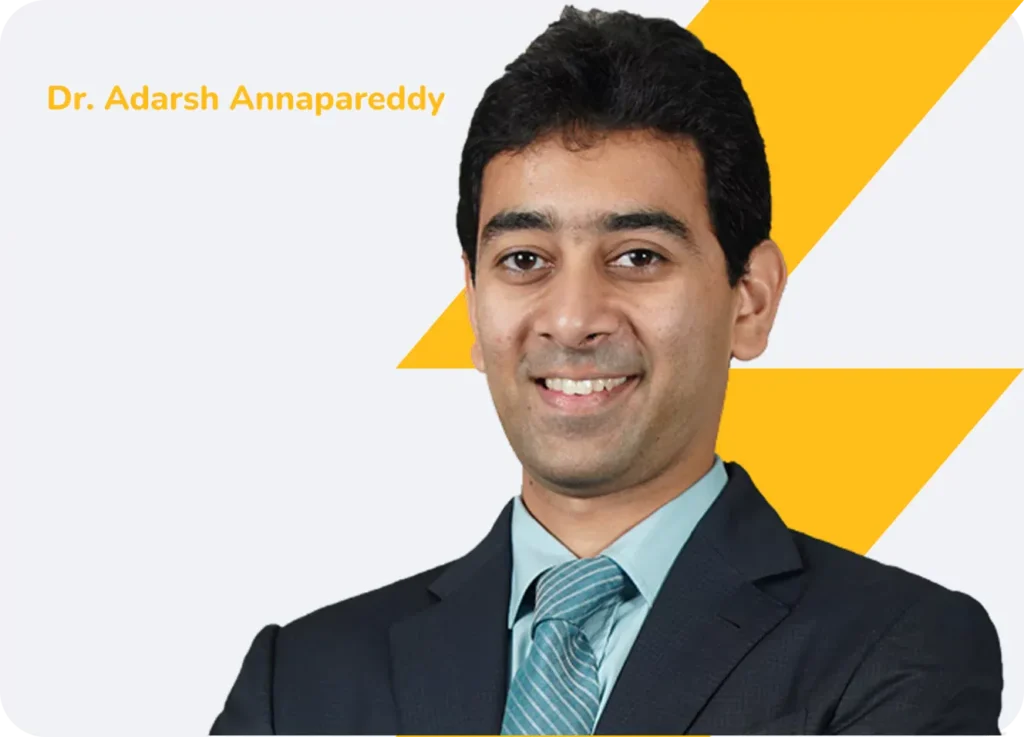
Knee replacement surgery, also known as knee arthroplasty, is a highly effective procedure designed to relieve pain, restore mobility, and improve the quality of life for individuals with severely damaged knee joints. Dr. Adarsh Annapareddy, a renowned knee replacement surgeon in Hyderabad, specializes in advanced knee replacement surgeries and offers tailored solutions to meet his patients’ unique needs.
Knee replacement surgery involves resurfacing the damaged knee joint by removing the affected cartilage and bone and replacing it with a prosthesis (artificial joint). The prosthesis is made of durable materials such as metal alloys, high-grade plastics, and polymers, designed to mimic the natural movement and function of the knee joint.
Depending on the extent of the damage, knee replacement surgery can be classified into:

The Knee Joint is one of the most important joints in the body. It’s a large joint made up of 3 bones – the femur, tibia and patella. It is a hinge joint – i.e. it moves in only one plane (unlike the hip and shoulder joints)
The knee joint bears the whole weight of the body therefore it is the joint most commonly affected by pain.
The Knee joint can be compared to a Car with the different parts of the joint resembling the functions of the parts of a car.
This helps to keep the joint moving smoothly. When this starts to dry up with age pain and difficulty in moving the joint starts.

The cartilage is the smooth tissue that covers the lower end of the femur and the upper end of the tibia (the bones that form the knee joint). It is thanks to the cartilage that the bone ends don’t rub against each other while we walk. With wear and tear of the joint, due to ageing, the cartilage starts to wear off and the underlying bone gets exposed and start to rub against each other causing pain – this is called osteoarthritis. This resembles the tyres of a car, wherein the wearing out of the tyres cannot be reversed but require changing of the tyres i.e. Knee Replacement surgery.
Surgical treatment is required when the fractured bone fragments are displaced away from each other and from their original position and when the fracture is next to a joint (like near the wrist or knee). Surgeries for fractures usually involve bringing the bone fragments back to normal position and holding them in place with screws or plates. These procedures give better chance of healing in proper position and faster than without surgery.

The meniscus is a tough tissue in the knee joint in between the two bones. There are 2 menisci – one on each side of the joint – and both are the shape of crescent moons. These menisci absorb the force that gets transmitted to the knee joint while we walk. The meniscus can get injured during twisting injuries usually sustained during certain sports like football and badminton.
The Anterior Cruciate Ligament (ACL) and the Posterior Cruciate Ligament (PCL) are 2 strong rope like tissues that hold both the bones of the knee joint (femur and tibia) together and prevent abnormal movements between them. They stabilize the joint in this manner. Twisting injuries of the joint can cause injuries to the ACL or PCL and lead to instability or giving way sensation in the joint.

Knee pain is a very common issue. It can happen in the older age group as well as in younger people. The causes of this pain is different in the different age groups.
The following are the different causes of Knee Pain –
This is basically the wearing out of the cartilage layer of the joint leading to the uncovered bone surfaces rubbing against each other and causing pain.

This is similar to the wearing out of a car tyre.
It occurs in the older age group – usually above 50 years of age.
Diagnosis – This condition is diagnosed with simple x-rays. On an x-ray we normally see some gap in between the two bones which is where the cartilage lies (not visible on an x-ray). After the cartilage wears out the gap between the two bones disappears and both bone ends appear to rub against each other.

Treatment – OA knee progresses through 4 stages and the treatment is different for different stages.

In early stages (1, 2 and 3) surgery isn’t required.

The exercises for the knee joint are shown in the video attached.
Other good exercises for the knee joint are cycling and swimming.

Treatment for Stage 4 OA of the Knee is surgical. There are 2 types of surgeries for the stage 4 OA – Total Knee Replacement (TKR) and Partial Knee Replacement (PKR or UKA).
These are explained in more detail in the attached videos and the next section.
This is the most common cause of knee pain in young adults. It is commonly seen in people in desk jobs like IT professionals as they sit for hours together without movement in the joint. It is usually felt in the front of the knee and most commonly whole getting up after sitting for a long time. The pain is caused by gradual softening of the cartilage leading to rubbing of the knee cap bone (patella) against the femur bone. Another cause of discomfort is the jamming of the synovial fluid in the joint due to not moving it regularly.
Diagnosis – X-rays help to diagnose the condition.
Treatment – This condition never requires a surgery. Simple medications, lifestyle modifications and exercises (similar to the ones mentioned in OA knee) are usually enough. A simple change to make while sitting at a desk is to make sure you get up every one hour and walk around for 5 minutes before sitting down to resume work.

This kind of pain is again more common in younger adults.
It is a pain which occurs after a twisting injury to the joint either during sports like basketball or while dancing. The pain is usually accompanied with swelling of the joint. It is also associated with painful locking of the knee (if the meniscus is injured) or giving way sensation or instability (if the ACL is injured).
Diagnosis – Sports injuries require MRIs to be diagnosed, not a simple x-ray.
Treatment – Initially conservative treatment is tried in the form of medicines rest and gradual exercises while using a knee brace.
If the injury is severe and not improving with conservative treatment a surgery known as arthroscopy is required (also known as a keyhole surgery). In this procedure a small incision is made in which a camera is passed to reconstruct the ACL or shave the torn meniscus.

This an autoimmune condition i.e. the immune system of the body attacks its own cells – leading to damage of the various joints of the body leading to pain and swelling.
This pain and swelling usually starts in the smaller joints of the body like those of the fingers and toes and then can progress to larger joints like the knees and hips. It usually manifests in the mid 20s to mid 30s age.
Diagnosis – X-rays can tell us if the joints are destroyed (similar to OA knee) A blood test called RA Factor gives us a confirmation of whether the person is actually suffering from Rheumatoid Arthritis.
Treatment – Treatment of RA should be done by a Rheumatologist who prescribes anti-rheumatoid medication. In severe stages where the knee or hip joints are completely destroyed an orthopaedic surgeon may have to perform a Knee or Hip replacement surgery.
Dr. Adarsh Annapareddy is a highly experienced orthopaedic surgeon known for his expertise in knee replacement procedures in Hyderabad. Here’s why patients trust him for their orthopaedic care:
Don’t let knee pain hold you back from enjoying life. Schedule a consultation with Dr. Adarsh Annapareddy, best knee replacement surgeon in Hyderabad, to explore your options and regain your mobility.
Contact us today to book an appointment!
Osteoarthritis is diagnosed with X-rays that reveal the narrowing of the joint space. Treatment varies by stage, with early stages managed through medications, physiotherapy, and lifestyle changes. Advanced stages may require total or partial knee replacement surgery.
Sports injuries are diagnosed with MRIs and are initially treated with rest, medications, and gradual exercises. Severe injuries may require arthroscopic surgery to repair damaged ligaments or menisci.
Posted on Google
 Ramanjaneya reddy Peddireddy3 April 2025
Trustindex verifies that the original source of the review is Google.
Underwent Total hip replacement under Dr.Adarsh sir.....3 months done walking perfectly.....inspired me before surgery and gave me confidence.....appreciate his perfectionPosted on Google Srijita031116 March 2025My mother recently had both her knee surgery done by Dr. Adarsh, a warm and empathetic doctor who won over our confidence immediately with his warm smile and affable nature. We had a lot of doubts and were actually quite scared about the whole procedure, but the way he explained everything to us and guided us at every step of the journey with patience and understanding, was truly amazing! It was an absolutely seamless experience at KIMS Sunshine Hospital, Gachibowli where the staff and entire team were very helpful. Dr. Adarsh's assistant Santosh was very cooperative as well, going out of his way to direct us to the right department for not only treatment purposes but also our insurance requirements. A big thank you to Dr. Adarsh and his entire team for giving wings to my Mom's travel dreams by giving a fresh lease of life to her both knees! 🙏 We just came back from Kerala and are planning our next trip already! ✈️Posted on Google
 Debnath Sur28 February 2025It was so wonderful experience for being treated by you sir .. I Debnath sur from bangladesh done my hip replacement surgery and the treatment was upto the mark... thank you Adarsh sir and the whole team for being supportive throughout the treatment.., 🙏🙏Posted on Google
 Samatha Reddy22 February 2025I had a wonderful experience at Sunshine Hospital. Dr. Adarsh was exceptionally skilled, kind, and took the time to explain everything in detail, making me feel comfortable and well-informed. The nursing staff was attentive and caring, ensuring that I received the best possible care. The hospital was clean, well-organized, and had a welcoming environment. I truly appreciate the dedication of Dr. Adarsh and the entire team. Highly recommend Sunshine Hospital for anyone seeking excellent medical carePosted on Google
 Sekar Ramachandran19 January 2025My wife (Mrs Uma Sekar Ramachandran ) had the privilege of being treated by Dr. Adarsh for her robotic knee surgeries of both the legs and I must say that it was a life-changing experience ! Dr. Adarsh's expertise, combined with his compassion towards patients made me feel at ease throughout the entire process. His PA, Mr. Santosh Kumar was also incredibly helpful and responsive to all my questions and concerns. His quick response is to be highly appreciated. I strongly recommend Dr. Adarsh and his team to anyone considering robotic knee surgery. 5 stars isn't enough - I'd give them 10 stars !Posted on Google
 Nagendra bogolu7 October 2024Dear Adarsh Sir, Hospital Team, I wanted to express my heartfelt gratitude for the exceptional care and treatment my father and I received at your hospital. Three months ago, my father underwent knee replacement surgery under Adarsh Sir's expert care, and his recovery was nothing short of miraculous. Recently, I underwent the same procedure and experienced an equally amazing outcome. I'm deeply thankful for: - Adarsh Sir's wonderful treatment, post-operative care, and sense of responsibility. - Santhosh Sir's invaluable assistance in connecting me with Adarsh Sir. Your dedication, expertise, and compassion have made a significant difference in our lives. We're forever grateful. Thank you for setting exceptional standards in healthcare. Sincerely, NagendraPosted on Google
 Upendar Reddy Kunduru17 July 2024My mother-in-law had her knee replacement surgery for both legs with Dr. Adarsh Annapareddy a month ago. From the initial consultation to till now, Dr. Adarsh and their team were exceptional. They explained everything clearly, answered all our questions, and made us feel at ease. The surgery was a huge success, and her knee function has improved significantly. The support staff was friendly, helpful, and made our experience seamless. I highly recommend Dr. Adarsh to anyone considering knee replacement surgery. They are a true professional with a passion for helping people. Thank you, Dr.Adarsh, for giving her life back!Posted on Google
 Venkat J16 July 2024Dr Adarsh did the robotic knee replacement surgery for my mom last month and we are happy with the progress my mom made till now. His explanation of the problem and the care during the whole process was excellent. Would definitely recommend to othersPosted on Google
 Subramaniam n15 May 2024I went to Dr. Adersh with lots of pain, begining of 4th stage . On 10th feb my robotic knee replacement surgery for my left leg was done by him. Just 60 minutes operation done . One day in ICU for observation. Next day discharged. From 3rd day I started walking with support. And after 14 days without support. now I am happily doing my routine work. I strongly recommend him to my friends and relatives. The best friendly doctor for knee replacement.Posted on Google
 Prathima Madireddy30 April 2024I was under Dr. Adarsh's care for a double total knee replacement surgery. I was taken care of him and his team before, during and post surgery really well. His team ensures your questions are answered and that gives a lot of assurance specially during recovery. Thank you Dr. Adarsh and team for your dedication for patient care!
Ground Floor, KIMS Sunshine Hospitals, Raidurg, Gachibowli, Hyderabad, Telangana – 500035
Copyright by Dr. Adarsh Annapareddy 2026. All rights reserved.