
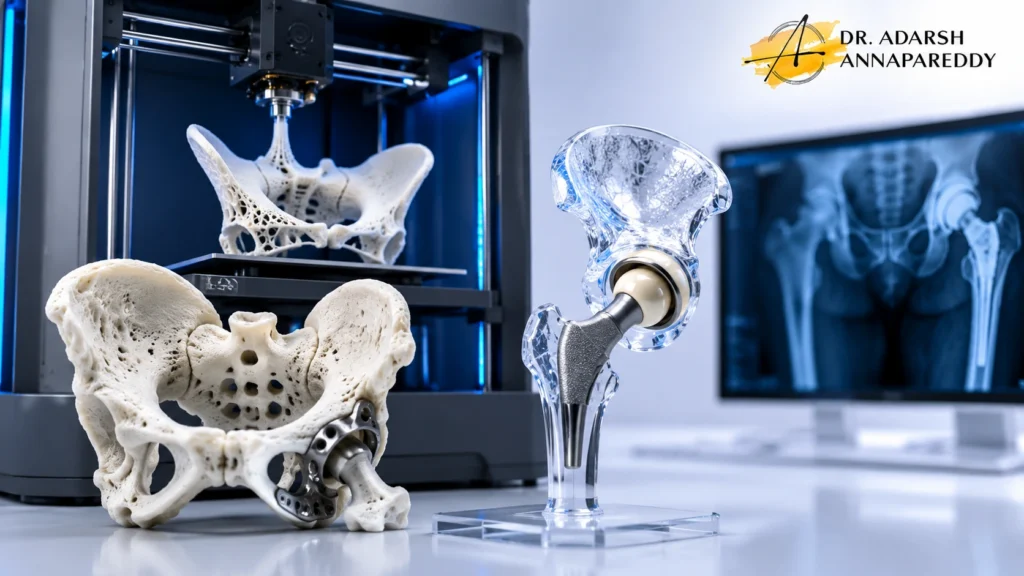
3D printing enhances revision hip surgery by producing patient-specific implants, surgical guides, and anatomical models. It improves surgical planning, boosts implant accuracy and stability, decreases operating time, and aids in managing complex bone defects. These benefits result in better patient outcomes and fewer surgical complications.
The term printing is no longer associated with two dimensional objects alone- 3D or 3 dimensional printing with specialised printers can be used to literally ‘print’ or make specific objects, once the blueprint with the exact measurements and the material to be used are given (much like using an ink cartridge). 3D printing has made great strides in orthopedics – by helping in the construction of customised joint parts. This is very important- as all of us have the same body structures but how they are placed will vary anatomically.
Let us look at how patient-specific implants for revision hip replacement can help you stay healthy and physically active for decades to come, with the proper care and maintenance in the long run.
Orthopedic 3D Printing Innovations To Know Of-
Orthopedic 3D implants for hip, knees and other joints can be made easily with 3D printing- and each patient can get implants that have been customized for them in particular. Such implants are made possible by using detailed blueprints or previously taken high resolution MRI and CT scans. Industrially mass produced implants fit many people, yes, but not everyone. That is where these 3D printers come in with printed implants- to ensure better fit and improve joint function and longevity.
Advantages of 3D Printed Implants For Revision Hip Surgery-
These are the well known benefits of 3D printing in revision hip replacement and for other such intricate procedures-
- Customisation which is patient specific- Implants are designed to suit the person’s unique anatomy. This means there is better fit and lesser chances of a mismatch in sizing or issues with the implant later on.
- Complex designs can be printed out- Implants printed can be porous and can integrate better with surrounding tissue.
- Lower surgical time– There is better accuracy with respect to how well the implant can be placed faster, without having to worry about maneuvering, which can cost time.
- Efficiency in the manufacturing process– Only the necessary amount of biomaterials/materials needed to print the implant out are used. There is no wastage of raw materials, like in the older processes, which rely on moulds or subtractive manufacturing. The process is hence more economical and efficient too. Materials that are routinely used include titanium alloys, cobalt chromium alloys, bioceramics for surface coatings and other polymers that are used in case by case applications.
In fact, titanium alloys are well known for their biocompatibility- where they remain and don’t interact with any cells or tissue in the body, along with having good durability and strength – characteristics that are important for a good implant. Cobalt-chromium alloys are used in weight bearing applications. Bioceramics can help bone regrow and is useful as a coating on bone surfaces. There are plenty of new advances being made in the field of materials chemistry and bioengineering and tissue modeling.
Disadvantages of Using Traditional, Mass Produced Implants-
The issues surgeons had with these implants were mainly with fit- poorer fit meant longer surgical times and greater risk of misalignment that could happen in the future. There was also a greater probability of the patient requiring revision surgeries later on. The manufacturing processes used to make these implants are also not as efficient, resulting in material wastage.
3D Printing Technology In Complex Hip Replacement Surgery/Revision Hip Surgery-
Hip replacement surgery is a complex procedure where parts of the damaged hip are surgically taken out and specific implants are inserted, to replace lost tissue. It is called complex because the scope is much bigger- and is used only for individuals who have severe bone deformities, who have pelvic fractures or are severely obese. Custom hardware and use of bone grafts becomes necessary in such cases.
These 3D printed implants can also be used for revision hip surgery, if the older implants have gotten worn down, or if there has been a recent dislocation, infection or any acute issue. Revision surgery is also much more technically demanding, when compared to primary hip replacements.
Conclusion-
We now know why using customised implants can help patients move with more confidence after getting the procedure done. If you have had any joint replacement surgery done before or are looking for 3D printed hip replacement surgery in Hyderabad, then please walk in to Dr. Adarsh’s Clinic – as we are the best orthopedic hospital for revision hip surgery, primary hip replacement, complex replacements and many other procedures that are designed to save lives and help protect independence and mobility.
Frequently Asked Questions
Revision hip replacement surgery is a procedure performed to replace or repair a previously implanted artificial hip joint that has failed or is no longer functioning properly. It may be recommended due to implant wear, loosening, infection, recurrent dislocation, fractures around the implant, or bone loss.
3D-printed implants are designed to match complex bone defects more precisely and provide better implant fit in revision hip replacement. They can improve implant stability, support bone integration, preserve remaining bone, and help surgeons address challenging cases with greater accuracy.
Yes. 3D-printed hip implants are manufactured using biocompatible materials such as titanium alloys and are designed to meet established safety and quality standards. When selected for appropriate patients, they provide durable fixation and promote bone growth into the implant surface.
A hip replacement can fail due to implant wear over time, loosening of the implant, infection, recurrent dislocation, fractures around the implant, or significant bone loss. The underlying cause is identified through clinical evaluation and imaging before planning revision hip replacement surgery.